Delaware Franchise Tax Explained: Dates, Fees, and How It's Calculated

Every year around March, a predictable email lands in a lot of founders' inboxes: a Delaware franchise tax notice with a number on it that doesn't match what anyone expected. Sometimes it's a few hundred dollars. Sometimes, for a company with a large authorized share count and modest assets, it's tens of thousands of dollars, calculated correctly, using the wrong method entirely.
That gap exists because Delaware gives every corporation a choice between two calculation methods, and the state defaults to the one that almost always produces the higher bill. This guide covers exactly how both methods work, every date you need to track, what happens if you're late, and how to check which method actually applies to you before you pay a cent more than you owe.
TL;DR
- Delaware LLCs, LPs, GPs, and LLPs pay a flat $300 annual tax, due June 1, with no annual report required.
- Delaware corporations pay a franchise tax calculated one of two ways, the Authorized Shares Method or the Assumed Par Value Capital Method, and you get to use whichever produces the lower number.
- The Authorized Shares Method is Delaware's default, and it can quietly produce a five-figure bill for a startup with millions of authorized shares and almost no assets.
- The Assumed Par Value Capital Method looks at your actual assets instead, and most early-stage startups land at its $400 minimum.
- Corporation franchise tax and the annual report are both due March 1. Miss it and Delaware adds a flat $200 penalty plus 1.5 percent interest per month, and continued non-payment eventually voids your charter.
- LedgerLine built a free calculator that runs both methods for you and tells you which one to file.
Table of Contents
- What Delaware Franchise Tax Actually Is
- Delaware LLC Franchise Tax
- Delaware Corporation Franchise Tax: The Two Methods
- Every Delaware Franchise Tax Due Date
- The Annual Report Filing Fee
- What Happens If You're Late
- Do Other States Have This Too
- Use the Calculator Instead of Guessing
- FAQ
What Delaware Franchise Tax Actually Is
Delaware franchise tax is not a tax on income. It's an annual fee charged for the privilege of being incorporated or formed in Delaware, and every Delaware entity owes some version of it regardless of revenue, profit, or whether the company did any business at all that year.
What you owe, and how it's calculated, depends entirely on what kind of entity you formed. LLCs, limited partnerships, general partnerships, and limited liability partnerships all pay a simple flat rate. Corporations are the exception, and their tax is calculated using one of two methods described below.
Delaware LLC Franchise Tax
If you formed a Delaware LLC, this part is simple. You owe a flat $300 per year, regardless of income, revenue, or activity. There's no annual report to file alongside it, just the payment itself, due June 1 every year. The same flat structure and June 1 deadline apply to Delaware LPs, GPs, and LLPs.
This is the entire calculation. There's no method to choose, no share count to look up, nothing to optimize. If you're an LLC, mark June 1 on your calendar and move on.
Delaware Corporation Franchise Tax: The Two Methods
This is where it gets more involved, and where most of the confusion (and most of the overpayment) happens.
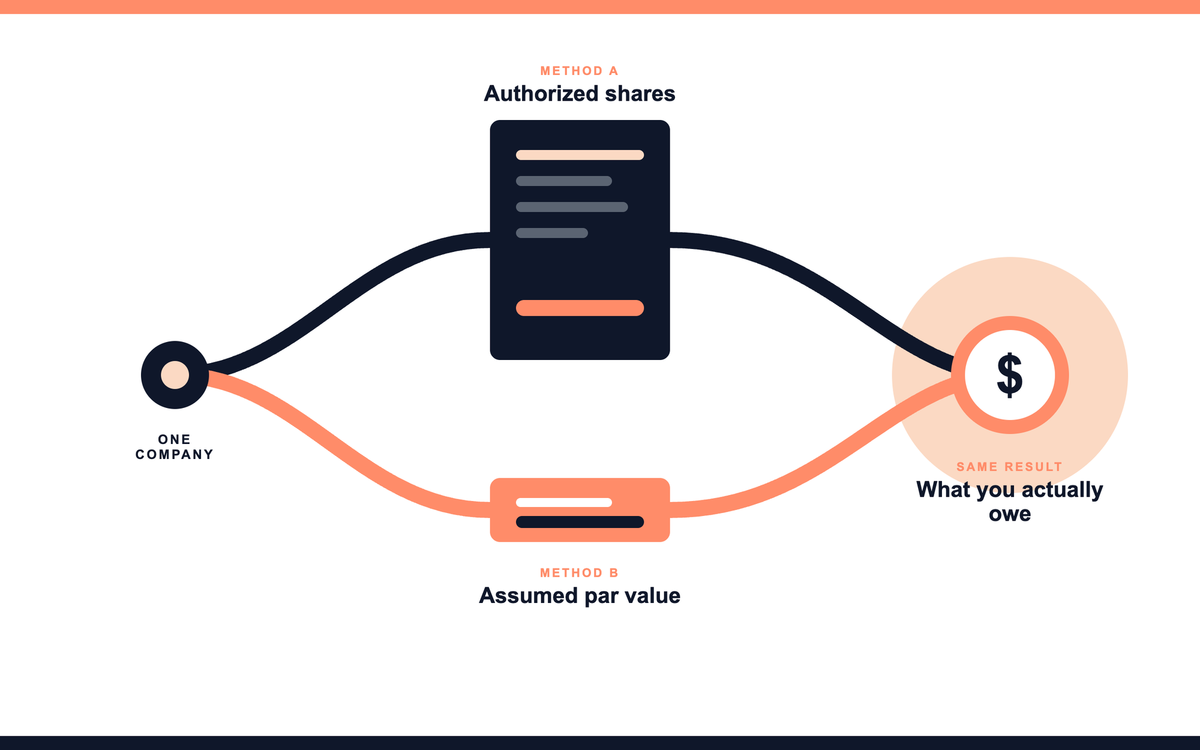
Delaware lets every corporation calculate its franchise tax two different ways, the Authorized Shares Method and the Assumed Par Value Capital Method, and you're allowed to use whichever one results in the lower tax. Delaware's own filing system defaults to the Authorized Shares Method, which is the simpler of the two but frequently the more expensive one for a typical startup.
Authorized Shares Method (the default)
This method ignores your assets entirely and looks only at how many shares your certificate of incorporation authorizes, whether or not those shares have actually been issued to anyone.
The bracket schedule:
| Authorized Shares | Franchise Tax |
|---|---|
| 5,000 or fewer | $175 (minimum) |
| 5,001 to 10,000 | $250 |
| Each additional 10,000 shares (or part of) | +$75 |
| Maximum | $200,000 ($250,000 for a Large Corporate Filer) |
Here's why this method catches founders off guard. Most startup certificates of incorporation authorize 10,000,000 shares or more, since it's standard practice to authorize a large pool upfront for future hires and fundraising rounds. Run that number through the table above: $250 for the first 10,000 shares, then 999 additional blocks of 10,000 shares at $75 each, and you land at $75,175. For a pre-revenue company with a handful of employees, that's a genuinely painful bill, and it's what a lot of founders assume they owe before they've heard of the second method.
Assumed Par Value Capital Method
This method calculates your tax based on your actual gross assets and issued shares instead of your authorized share count, and it's the one most early-stage startups should actually use.
The formula, in order:
- Divide your total gross assets (from Form 1120, Schedule L) by your total issued shares. This gives you your assumed par value per share.
- For any authorized shares with a stated par value below your assumed par value, multiply your assumed par value by that share count.
- For any authorized shares with a stated par value above your assumed par value, use their actual stated par value instead, multiplied by that share count. Most startups with a single class of common stock at a fraction of a cent par value won't hit this step at all.
- Add the results of steps 2 and 3 together. This is your Assumed Par Value Capital.
- Divide that number by $1,000,000, rounding up to the next whole million if there's a remainder, then multiply by $400. That's your tax.
- The minimum tax under this method is $400.
A worked example. Say your company has $50,000 in total gross assets, 6,000,000 issued shares, 10,000,000 authorized shares, and a par value of $0.0001, a typical early-stage setup.
Assumed par value: $50,000 ÷ 6,000,000 = $0.008333 per share. Since $0.008333 is above the stated par value of $0.0001, all authorized shares get counted at the assumed par value: $0.008333 × 10,000,000 = $83,330. $83,330 ÷ $1,000,000 rounds up to 1, multiplied by $400, equals $400, the minimum.
Same company, same authorized share count. $75,175 under the Authorized Shares Method, $400 under the Assumed Par Value Capital Method. That gap is the entire reason this method exists, and why Delaware explicitly requires you to compare both before filing.
Companies with more than one class of stock, common and preferred after a priced round, for example, go through the fuller version of steps 2 and 3 above, since preferred shares often carry a higher stated par value than assumed par. The math still holds, it just has an extra line.
Which Method Should You Use
Run both and file whichever number is lower. For most bootstrapped or early-stage startups with a large authorized share pool and modest assets, that's the Assumed Par Value Capital Method, usually landing at or near the $400 minimum. For a company with very few authorized shares and substantial assets, the Authorized Shares Method can occasionally come out lower, so it's worth checking both rather than assuming.
Every Delaware Franchise Tax Due Date
| Entity | What's Due | Due Date |
|---|---|---|
| LLC, LP, GP, LLP | Flat $300 tax, no report | June 1 |
| Corporation | Franchise tax + annual report | March 1 |
| Corporation owing $5,000+ | First estimated installment (40%) | June 1 |
| Corporation owing $5,000+ | Second estimated installment (20%) | September 1 |
| Corporation owing $5,000+ | Third estimated installment (20%) | December 1 |
| Corporation owing $5,000+ | Remaining balance | March 1 (following year) |
That last row catches funded companies off guard the most. If your corporation's annual franchise tax liability hits $5,000 or more, Delaware requires quarterly estimated payments throughout the year rather than one payment in March, with the final true-up due the following March 1 alongside your annual report.
The Annual Report Filing Fee
Corporations pay a separate annual report filing fee on top of the franchise tax itself, $50 for a standard non-exempt domestic corporation, $25 for certain exempt corporations. The report requires the names and addresses of all directors and at least one officer, current as of the filing date. LLCs and the other flat-rate entities don't file an annual report at all, just the $300 payment.
What Happens If You're Late
Miss the deadline and Delaware adds a flat $200 penalty, plus interest at 1.5 percent per month on both the unpaid tax and the penalty itself. That interest compounds every month it stays unpaid, so a bill that starts small doesn't stay small for long.
Keep ignoring it and the consequences go past interest. Delaware can void your corporate charter for continued non-payment, at which point the company isn't in good standing, can't get a certificate of good standing (which banks, investors, and acquirers all ask for at some point), and reinstating a voided entity means paying every year of back taxes, penalties, and interest, plus a reinstatement fee, before you're current again.
Do Other States Have This Too
Delaware isn't the only state with a franchise-tax-style fee, though it's the one that comes up most often since it's where the majority of VC-backed startups and a large share of US-incorporated companies are formed. California charges a flat minimum franchise tax that applies regardless of income, notably even to LLCs there. Texas uses a revenue-based franchise tax (technically a margin tax) with a no-tax-due threshold below a certain revenue level. If you're formed in Delaware but foreign-qualified in another state because you actually operate there, check that state's own franchise tax rules separately, since forming in Delaware doesn't exempt you from them.
Use the Calculator Instead of Guessing
Running both methods by hand is exactly the kind of task where a small input error turns into a five-figure mistake. LedgerLine built a Delaware Franchise Tax Calculator that runs both the Authorized Shares Method and the Assumed Par Value Capital Method side by side, using your actual authorized shares, issued shares, and gross assets, and tells you which one to file.
[Tool link slot: LedgerLine's Delaware Franchise Tax Calculator, URL to be added once the tool page is live.]
FAQ
How is Delaware franchise tax calculated for a corporation? Delaware corporations calculate their tax using one of two methods, the Authorized Shares Method (based purely on how many shares are authorized) or the Assumed Par Value Capital Method (based on actual gross assets and issued shares). You're required to compare both and file whichever produces the lower tax.
What is the minimum Delaware franchise tax? $175 under the Authorized Shares Method, or $400 under the Assumed Par Value Capital Method. LLCs, LPs, GPs, and LLPs pay a flat $300 regardless of method, since there's only one calculation for those entity types.
When is Delaware franchise tax due? March 1 for corporations, alongside the annual report. June 1 for LLCs, LPs, GPs, and LLPs, which don't file an annual report at all.
What happens if I pay Delaware franchise tax late? A flat $200 penalty applies immediately, plus 1.5 percent interest per month on the unpaid tax and penalty. Extended non-payment can lead to Delaware voiding the corporate charter, which requires a full reinstatement process to fix.
Do I have to pay Delaware franchise tax if my company had no revenue? Yes. Franchise tax isn't based on income or revenue at all, it's charged for the entity's existence, so a $0-revenue company still owes it every year it remains active.
Which franchise tax method should a startup use? Most early-stage startups with a large authorized share pool and modest assets end up owing far less under the Assumed Par Value Capital Method, often the $400 minimum. Run both methods rather than assuming, since the gap between them can be tens of thousands of dollars for the exact same company.
Closing
Delaware franchise tax isn't complicated once you know which method you're supposed to be using, it's just easy to get wrong by accident, and getting it wrong by accident is expensive. Know your entity type, know your two dates, and never file the Authorized Shares Method number without checking what the Assumed Par Value Capital Method says first.
If you'd rather not run this math by hand every March, LedgerLine's calculator does both methods for you and handles the filing: ledgerline.xyz.