Ignoring this form 5472 can drive $25000 penalty even if your entity have zero revenue


You incorporated US entity easily without any problem, EIN is approved, bank account is also opened. You wired $5000 to get started, fast forward a year; later you have not yet sold anything. No customers, No revenue and No invoices but Eighteen months later, an envelope from the IRS shows up. Penalty: $25,000.
It happens to most of the founders, you're not alone because no one told them about this form 5472. If you own a US entity from anywhere outside the US this is the one piece of compliance you cannot afford to wave away. So let's break it down properly.
What Form 5472 actually is?
It is an information return. That phrase matters. It's not a tax bill. You're not necessarily paying anything when you file it. You're just reporting specifically, you're telling the IRS about transactions between your US entity and its foreign owners or related parties.
The US government uses it to keep an eye on money moving across borders and to make sure foreign-owned entities aren't being used to quietly shuffle value out of the country. Whether or not your company owes a cent in tax, the IRS still wants the report.
That's the trap. Founders assume "no revenue, no tax, no filing." For most US tax obligations that instinct is roughly right. For Form 5472, it's dead wrong.
Who has to file it?
Two groups need to care, and the second one is where most founders land.
1. US corporations that are at least 25% foreign-owned. If a foreign person or entity owns a quarter or more of your US C-corp, and there was a reportable transaction during the year, you file.
2. Foreign-owned single-member LLCs. This is the big one. Since 2017, a US single-member LLC owned by a foreign person is treated as a "disregarded entity" that must file Form 5472 attached to a pro forma Form 1120. If you're a non-resident who set up a Delaware or Wyoming single-member LLC, the default move for most founders building for a US market — this is you.
"Foreign person," by the way, just means you don't hold a green card and don't meet the US substantial presence test. If you're running your company from India, you qualify.
The kicker: this applies even to dormant LLCs. Zero revenue doesn't get you out. An LLC that exists but does nothing all year still has reportable transactions hiding in it which brings us to the part everyone underestimates.
What counts as a "reportable transaction"?
When founders hear "transaction," they think sales. The IRS means something far broader: basically any value moving in either direction between you and your company, including things that never involved cash.
Here's what catches people:
- Your own capital contribution. The money you put into the LLC to start it is reportable. That's why the founder with $5,000 and no customers still triggered a filing.
- Formation and maintenance costs. Paying for the company to exist counts.
- Loans ( even interest-free ones). Lending your own company money? Reportable. A foreign parent lending its US subsidiary $10,000 at 0% interest still has to be reported, even though no interest changed hands.
Example: If the founder made a transaction from his/her personal account and then later got it reimbursed from the US entity - Non-cash arrangements. Property transfers, letting the company use your IP royalty-free, providing services without payment, below-market deals all reportable at fair market value, even when no money moved at all.
So the question is never "did I make money?" It's "did anything of value pass between me and my US entity?" For a funded-but-dormant LLC, the answer is almost always yes.
The penalty is so brutal
The base penalty is $25,000 per form. Not a percentage of anything. A flat $25,000 for failing to file on time, filing something substantially incomplete, or failing to keep proper records.
It gets worse from there:
- Per related party. You file a separate Form 5472 for each related party. Two related parties across five missed years can stack up to $250,000 ($25,000 × 2 forms × 5 years).
- It keeps growing. If you don't fix it within 90 days of the IRS notifying you, another $25,000 hits — and then another $25,000 for every additional 30 days. There is no maximum cap.
And the consequence that's quietly the scariest: there's no statute of limitations. Normally a tax return "closes" after a few years and the IRS can't come back to it. Miss a Form 5472 and your entire return stays open indefinitely. The IRS can come knocking on a 2019 filing in 2027. The clock never starts.
When and how to file?
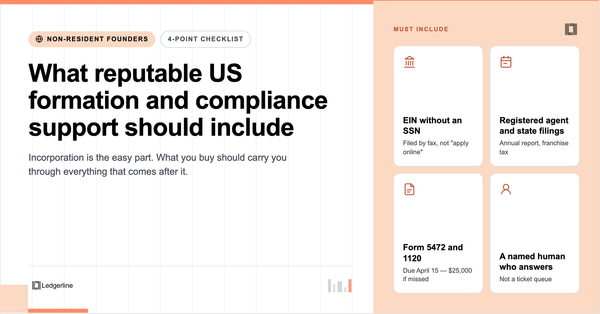
- Deadline: It lines up with the Form 1120 deadline April 15 for calendar-year filers attached to a pro forma 1120.
- Extension: File Form 7004 by April 15 and you get until October 15. But remember: an extension covers filing, not paying. Any actual tax owed is still due April 15.
- The mechanics for single-member LLCs: Write "Foreign-owned U.S. DE" across the top of the pro forma 1120. And note foreign-owned disregarded entities can't e-file. You mail or fax it. In 2026. Yes, really.
- Recordkeeping: Keep everything for at least 7 years. Failing to maintain adequate records is its own $25,000 trigger.
The mistakes that cost founders money
After seeing enough of these, the same errors repeat:
- Assuming dormant = exempt. The most expensive assumption in non-resident compliance.
- One form for multiple parties. Each related party needs its own form. Combine them and you're effectively short a filing.
- Forgetting attribution. Ownership by your spouse, your children, and entities you control all count toward the 25% threshold. The IRS adds up the family.
- Ignoring the non-cash stuff. Interest-free loans and free use of property are the silent killers.
- Confusing it with BOI. Form 5472 and FinCEN's Beneficial Ownership Information report are completely separate obligations. Filing one does nothing for the other.
If you've already missed it
First: don't panic, and don't ignore it, ignoring it is what turns a $25,000 problem into a $250,000 one.
There's a path back. The IRS runs Delinquent International Information Return Submission Procedures that let you come into compliance with a reasonable-cause statement explaining why you missed it. The general move is to file for every year the entity has existed (or back to 2017, whichever is later), all at once, and ideally before the IRS sends a notice, because that's when the penalties start escalating.
This is one of the few areas where doing it yourself to save a few hundred dollars can backfire into five figures.
Book a call with our expert team, we helped more than 100 founders get penalty waived completely.
Use this tool to see if you should file form 5472 or not https://ledgerline.xyz/tools/form-5472-penalty-analyser