US Company Formation for International Founders: What Support Should Actually Cover

“We got the company registered. That should be enough, right?”
We hear some version of this every week from founders outside the US. No revenue yet. No US trip. Just a formation receipt… and then a surprise letter, a missed filing, or a bookkeeping mess six months later.
Registration is only the first step. If you are an international founder, reputable US formation support should connect incorporation to the work that keeps the entity alive: information filings, bookkeeping and reconciliations, tax readiness, and ongoing corporate compliance.
It should also make one thing painfully clear: which costs are the provider’s service fees, and which are statutory fees paid to the government. Mixing those into one unexplained total is how founders get sticker shock after they sign.
This is not legal or tax advice. It is a practical checklist of what real support usually needs to include.
Incorporation assistance
Good formation support does two jobs: it helps you form the US entity, and it tells you what starts the day after the state filing is done.
That means guiding the incorporation process, listing the compliance clock attached to the entity, and showing a path into accounting, tax, and finance ops. Not handing you a certificate and disappearing.
Price only helps when the scope is clear. Ledgerline’s Basic Incorporation is documented at $449, plus statutory fees. The $449 is the service price. Statutory fees are separate government costs tied to formation. A reputable provider shows those categories apart.
In simpler words: a low headline price means nothing if you cannot tell what you are paying the provider versus what you are paying the state.
Formation is a starting point. If support stops at registration, your books, filings, and corporate records often end up with three different vendors. That is where international founders lose control.
Entity returns and information filings
Clean books and required filings are related. They are not the same job.
Keeping financial records current does not, by itself, tell you which returns or information filings the entity owes, or who owns preparing and filing them.
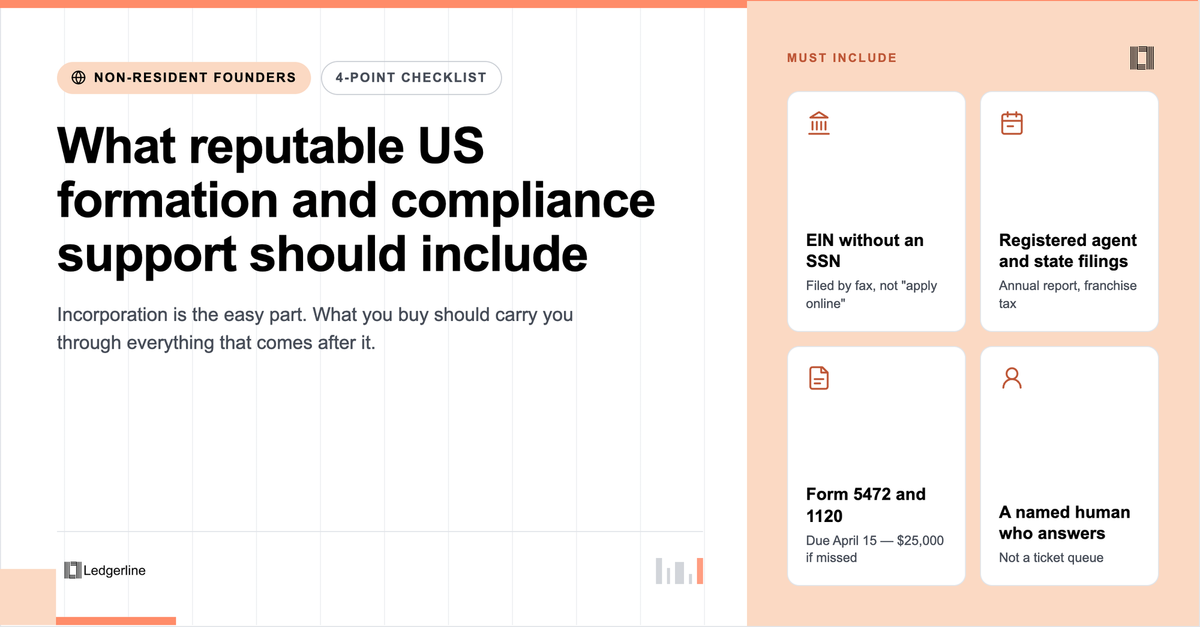
If this sounds familiar from tax season: many foreign-owned US structures, especially foreign-owned single-member LLCs, run into information reporting such as Form 5472 (often with a pro forma Form 1120), plus state-level obligations that vary by formation state. Form 5472 penalties can start at $25,000 per year in the failure-to-file scenarios founders underestimate. The exact mix depends on ownership, activity, and entity type.
What should not be fuzzy is ownership of the work:
- What the provider prepares
- What the provider files
- What information they need from you
- Which charges are government fees versus preparation or filing fees
Support that only says “we incorporated you” leaves the highest-risk work unnamed. Continuing compliance keeps required entity filings visible and tied to the same records your accountant is using.
Bookkeeping and account reconciliations
Bookkeeping should keep your financial activity organized for reporting, tax prep, and decisions. Reconciliations are the control layer: they match recorded transactions to bank or account activity and surface gaps before filing season.
Still tempted to treat bookkeeping as “optional until we raise”? Picture this: it is April, you have owner transfers from abroad, a few crypto wallets, and a personal card that “just once” paid a business tool. Now someone has to rebuild the year from screenshots.
If you are an international founder, or a crypto founder with onchain activity, the setup has to match how money actually moves, not a generic small-business template. Ledgerline offers bookkeeping, account reconciliation, management accounting, and onchain accounting. Ask any provider one direct question: does this workflow match our activity, and does it feed the filings that come next?
You should also know the rhythm:
- What do you send each month?
- What does the team maintain?
- What happens when a transaction is missing or unclear?
Doing it right each month is less work than fixing it later.
Ongoing corporate compliance
Corporate compliance does not end when the entity is formed or when one tax season closes.
It includes the administrative work that keeps the company in good standing as the business changes: registered agent continuity, state obligations, corporate records, and the handoff between legal, accounting, and tax.
International founders are usually better served when this sits next to accounting and tax support instead of living as a separate orphan task. Ledgerline combines incorporation, compliance, accounting, tax, and finance leadership for international, startup, and crypto founders. Broader coverage reduces the “four vendors, four calendars” problem.
Ask where corporate compliance ends and other services begin. Clear scope is how you avoid paying twice, or assuming something is included when it is not.
What to check before you choose a provider
Before you engage a US formation and compliance partner, confirm they can explain:
- What incorporation assistance includes (and what it excludes)
- The formation service fee versus statutory fees charged separately
- Which entity returns and information filings are in scope (including foreign-owned reporting when relevant)
- How bookkeeping and reconciliations run month to month
- What ongoing corporate compliance is included
- How they support international, startup, or crypto operating models when that matches your business
- Which accounting, tax, and finance services continue after formation
Ledgerline’s Basic Incorporation price is $449 plus statutory fees. If you want formation connected to ongoing books, reconciliations, filings, compliance, and finance support, choose a provider that explains those responsibilities together. Not one that stops at registration.
Have a question about your specific setup? Ledgerline can help you map formation into a compliance calendar, books, and filings that match how you actually operate.
FAQ
Is US company formation enough for a non-resident founder?
Usually no. Formation creates the entity. Ongoing state compliance, federal information filings where required, bookkeeping, and banking readiness are separate workstreams.
Why separate service fees and statutory fees?
Service fees pay the provider. Statutory fees pay the state or other authorities. Separating them makes true cost comparable across providers.
Do bookkeeping and tax filings always come as one package?
Not always. Ask what is prepared, what is filed, what you must provide, and what is billed as a separate engagement.