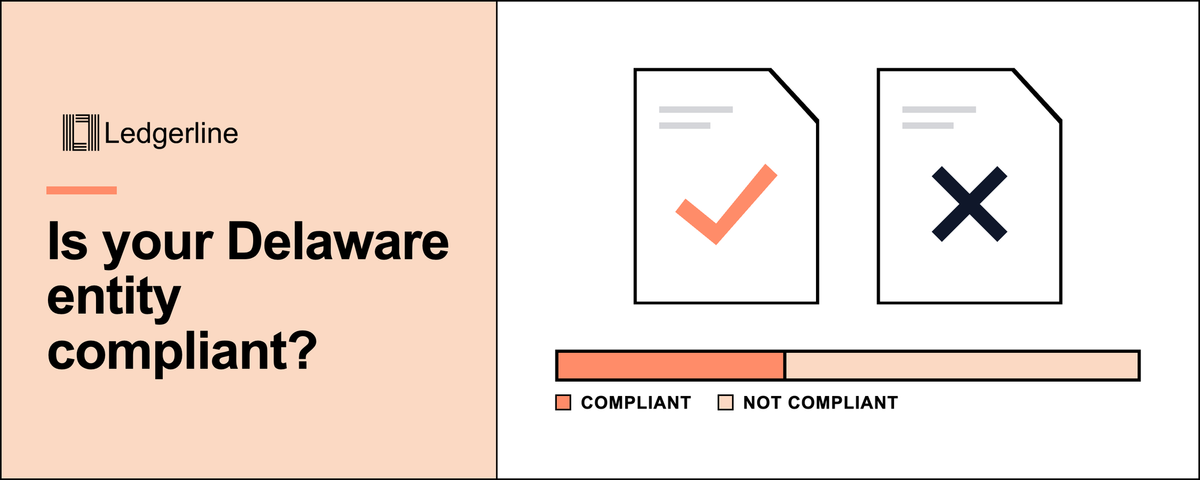
61% of the Indian founded VC backed Delaware companies we checked have a compliance flag right now

A Delaware entity does not send a warning before it quietly falls out of compliance. There is no popup, no dashboard alert, nothing that interrupts your day. The company keeps running, the product keeps shipping, and the filing obligation just sits there, unattended, until someone tries to raise a round, close an acquisition, or open a bank account and discovers the company has not been in good standing for over a year.We wanted to know how common that actually is among Indian founded, VC backed companies. Delaware is where the overwhelming majority of them incorporate. So we pulled the franchise tax status directly from Delaware’s own public portal for 114 such companies which raised funding in the past 6 years. What we found was not a handful of stragglers. It was a clear pattern, and most of it traces back to two specific, fixable mistakes.
What We Actually Looked At
We used Delaware’s Division of Corporations franchise tax portal to check the current filing and payment status of 114 Delaware entities tied to Indian founded companies that have raised venture funding. This is the same public record any founder, investor, or acquirer can pull by entering a company’s file number, the same record that determines whether Delaware will issue that company a Certificate of Good Standing today.The Headline NumbersOf the 114 companies reviewed:
- Fully compliant, nothing flagged: 45 (39%)
- Filed, but with a notice on record: 49 (43%)
- Active payment currently due: 16 (14%)
- Serious issue (unfiled return, inactive entity, or formally flagged noncompliant filing): 14 (12%)
- Could not be located in the portal at all: 3 (3%)
Put together, 61% of the companies we checked have some kind of flag on their record right now. That is not a rounding error. That is the majority.
Root Cause One: Your Registered Agent’s Address Is Not Yours
This is the mistake we could trace most directly, because Delaware itself flags it explicitly on the filing.Under Delaware law, a corporation’s annual report has to list the company’s actual principal place of business, its real physical operating address, not the address of its registered agent. Delaware clarified this rule in a 2022 amendment and is actively enforcing it right now. A recent legal alert from a major corporate law firm describes Delaware identifying noncompliant filings and blocking Certificates of Good Standing until they are corrected, exactly when a company can least afford the delay: in the run up to a financing or an acquisition closing.This mistake is easy to make and almost invisible once it is made. Most founders form their Delaware entity through a registered agent or formation service, which handles the paperwork, including the annual report, on autopilot. If nobody actively replaces the placeholder address with the company’s real one, the filing quietly lists the registered agent’s Delaware office as the company’s principal place of business. Delaware now checks for exactly this and flags it.The fix is not complicated. Your principal place of business should be wherever your company actually operates from. For most early stage, remote first teams, that is simply a founder’s home address, not a registered office in a state where nobody on the team has ever set foot. If that has changed since your last filing (or was never correct in the first place), an amended annual report fixes it for a modest filing fee. It is worth doing before it surfaces during a financing, not during one.
Root Cause Two: Accepting the Portal’s Default Number during franchise tax filing
This one does not get flagged by Delaware at all, because it is not technically wrong. It is just expensive.Delaware calculates corporation franchise tax two different ways: the Authorized Shares Method and the Assumed Par Value Capital Method. It lets you file under whichever produces the lower number. The problem is that Delaware’s own portal defaults to the Authorized Shares Method, which counts your authorized share pool regardless of what your company actually owns.A typical startup with a large authorized share count and modest assets can see a bill in the tens of thousands of dollars under this default. The same company, filed under the Assumed Par Value Capital Method using its actual assets and issued shares, often lands at the $400 minimum instead.Nobody tells you to check. The portal shows you a number, there is a “pay” button right next to it, and most founders (or whoever is handling compliance) just pay it.
What This Actually Looks Like
A few patterns from the dataset (described generally rather than by name, since a couple of these are still active, unresolved filings):Two companies carry Delaware’s explicit “Non Compliant” flag directly on their annual report, requiring an amended filing before anything else can move forward. One of those has gone further: its entity status now reads inactive outright. Paying the overdue amount alone will not restore good standing. It requires direct contact with Delaware’s Division of Corporations.Several of the largest overdue balances (ranging from roughly $190,000 to just over $300,000) trace back to a simpler cause: the annual report for the most recent tax year was never filed at all. No amendment needed, no address issue, just an accumulating bill for a filing nobody submitted.Scattered through the middle are the quieter cases: companies that filed on time, are not in any danger of losing good standing, but are still paying a franchise tax number that was never checked against the lower alternative.
How to Check Your Own Status?
You do not need to guess. Delaware’s franchise tax status is public information, searchable directly through the Division of Corporations using your company’s file number (the same number on your original Certificate of Incorporation). It will show you exactly what we pulled for this analysis: whether your most recent report was filed, whether it is flagged, and whether anything is currently due.Fixing It
- If your filing lists a registered agent’s address as your principal place of business, file an amended annual report with your actual operating address.
- If you have never checked which franchise tax calculation method your company is using, run both and compare before your next payment.
- If your entity status has slipped to inactive or noncompliant, resolve it before it becomes a blocker in a financing or acquisition, not during one.
FAQs
Can a Delaware corporation list its registered agent’s address as its principal place of business?
No, not unless the company genuinely operates from Delaware and serves as its own registered agent. Under 8 Del. C. 502(a)(3), the annual report must list the company’s actual physical operating address. Delaware has been actively enforcing this since a 2022 amendment.
What happens if Delaware flags my company as noncompliant?
The company cannot obtain a Certificate of Good Standing until the issue is fixed. That is a problem the moment you are raising a round, closing an acquisition, or opening certain bank accounts, since all of those typically require one. Most noncompliance of this kind is fixed with an amended annual report.
Why did my Delaware franchise tax bill come out so high?
Delaware’s portal defaults to the Authorized Shares Method, which is based purely on how many shares your company has authorized, not what it actually owns. Most early stage startups with a large authorized share pool and modest assets owe far less under the alternate Assumed Par Value Capital Method. You are allowed to file under whichever number is lower, but you have to calculate it yourself.
How do I check if my company is currently noncompliant with Delaware?
Search Delaware’s Division of Corporations franchise tax portal using your company’s file number. It will show your filing history, any notices, and any amounts currently due.
Is this a problem specific to Indian founded startups?
The underlying rules apply to every Delaware entity. What we found is that it shows up especially often among Indian founded, VC backed companies, likely because compliance is frequently handled remotely, informally, or by whoever set up the entity initially and never touched it again.
Closing
None of what we found here is exotic. It is two specific, well documented, entirely fixable mistakes, repeating across the same kind of company again and again, mostly because nobody was specifically looking for them. A Delaware entity does not announce when it has fallen out of compliance. It just sits there, quietly accumulating a bill, until someone finally checks.